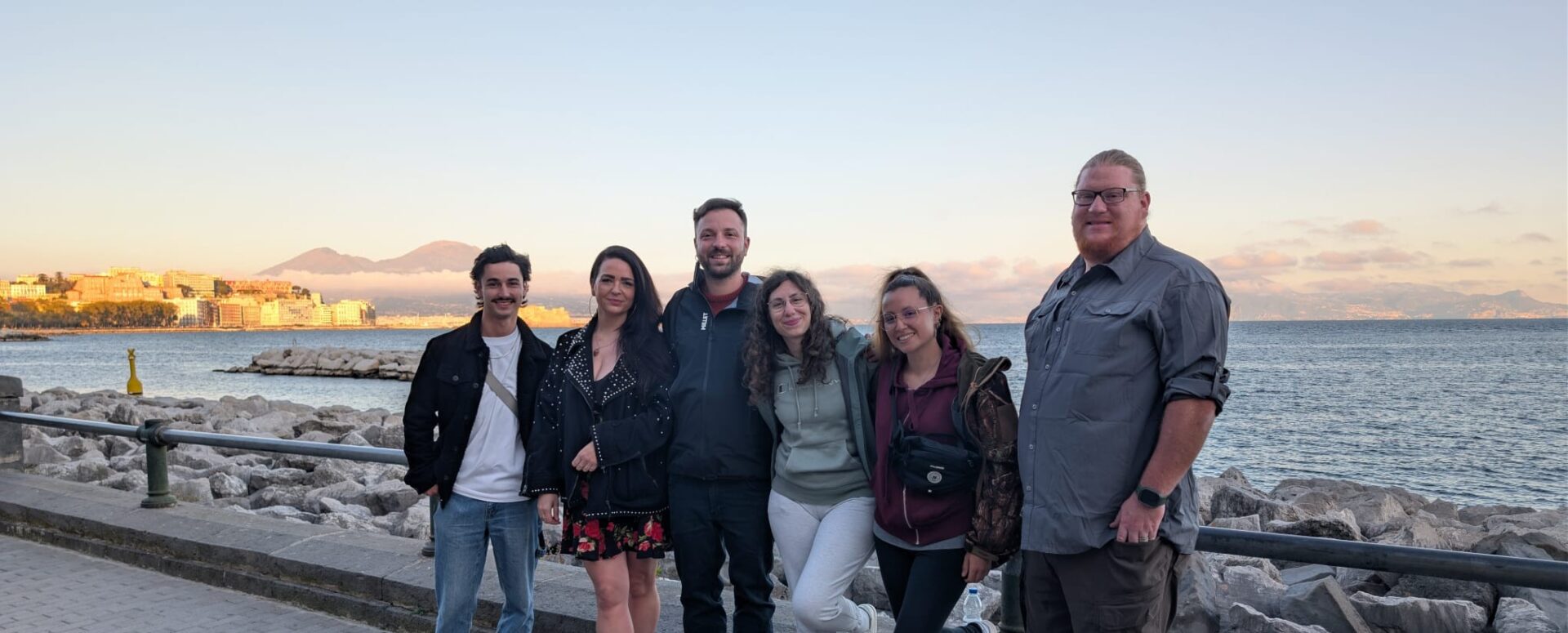

We have finally reached the culminating moment of our Eco.Cá project, carried out within the regional FUNT funding program, which focused on promoting Campania (Southern Italy) as a high-quality destination for ecotourism and birdwatching. Between April 7th and 14th, we organized an international birdwatching press tour in Campania, hosting five content creators from different countries. The result? An experience that exceeded all expectations.
Accompanying us on this adventure were Jacob (birdingwithcob) from Australia, Marshall (marshall.travels) from the United States, Jade (natureisakingdom) from the United Kingdom, and Lisa (lisasanimalss) and Chiara (chiaratalia_birds) from Italy.
Here is the report of this wonderful adventure, where we will try to tell the story through words and photographs (both ours and those of our participants).
Campania, in fact, is not only one of the most well-known Italian regions worldwide for its outstanding cultural, historical, and gastronomic offerings, but also a lesser-known and less explored territory with an extraordinary potential for ecotourism. It is not just the land of Naples, Capri, Sorrento, and Pompeii, but also “home” to more than 200 bird species (along with many other wildlife species) that can be observed here throughout the different seasons.
Over the course of this experience, our region amazed not only our guests, but even us. Despite being used to exploring it far and wide, including its most remote corners over the past ten years, we still discovered new places that quite literally left us speechless.
Let us now continue with the story, hoping to share with our readers at least a small part of the emotions that accompanied us throughout this journey, and to spark – both in those who already know the region and in those who think they know it well – the curiosity to further explore the natural treasures that Campania has to offer.
DAY 1
On the first day, we welcome our guests with a walk along the Naples seafront, one of the most evocative settings for an urban birdwatching experience. We are lucky: visibility is outstanding, and the view of Mount Vesuvius and the Gulf provides the perfect way to begin this adventure.
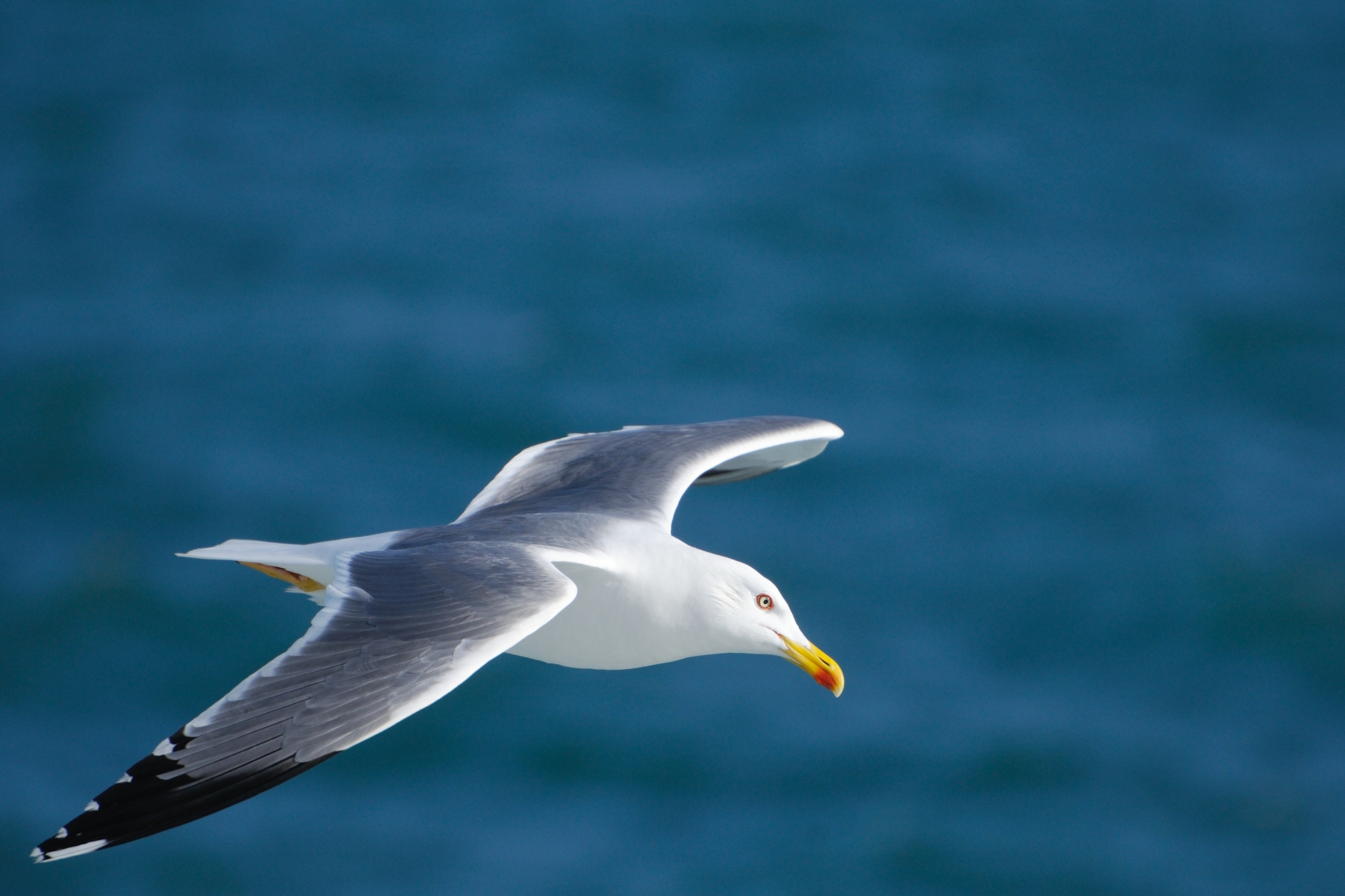
We immediately start with some classic sightings of urban birdwatching in Naples, recording our first Common and Alpine Swifts (Apus apus, Tachymarptis melba), the last Great Cormorants (Phalacrocorax carbo) of the season resting on the breakwaters, and the ever-present Yellow-legged Gulls (Larus michahellis).
After a welcome aperitif, it is time for our first dinner together: pizza, of course – and of exceptional quality. We do not linger too long, though; an early wake-up call awaits us the next morning.
DAY 2
Before dawn, we pick up our guests at the hotel and head south, as the first stop of the tour is in the province of Salerno.
Although the Amalfi Coast is not officially part of the itinerary (our aim is to promote alternative destinations and help reduce the congestion of heavily touristed areas), we cannot resist stopping in Cetara for breakfast, enjoying along the way one of the most beautiful views in the world. Jacob is already getting excited about photographing the Italian Sparrow, which – despite being a common species for many – is one of his main targets, as it represents the only true endemic bird species that can be encountered during the tour.
We do not waste much time, however, and continue on to the WWF Oasis of Persano (Salerno), a place we have loved since childhood and simply could not leave out of the project. This area is one of the main birdwatching hotspots in southern Italy, thanks to its variety of habitats and its strategic position along migratory routes.
As soon as we park, we begin spotting the first interesting species, and Marshall reaches a long-awaited milestone: the thousandth species on his personal life list: a Red Kite (Milvus milvus)!
Migration activity seems rather slow, but we still manage to observe some of the first target species, such as Zitting Cisticola (Cisticola juncidis), Little Ringed Plover (Charadrius dubius), and the very first Northern Wheatear (Oenanthe oenanthe) of the trip – and, for us, of the year.

After a quick lunch break, we head towards the Cilento, Vallo di Diano and Alburni National Park, one of the most promising areas for ecotourism in Campania.
It is a territory we have explored extensively – and learned to love deeply – over the past few years through monitoring projects such as those on Wolves and R.A.MO.CA. (focused on arboreal Rodents), and we were eager to showcase its potential from an ecotourism perspective.
Here we stay at the wonderful agriturismo Terra Nostra, our indispensable base camp for all field activities, where every time – including this one – we are welcomed as if we were coming home.
Before and after a lavish dinner featuring local products, we dedicate ourselves to searching for amphibians around the property. Within just a few hundred meters, and to Lisa’s great delight (as she was also celebrating her birthday that very day), we manage to observe several small herpetological gems, including the Italian Newt (Lissotriton italicus), Italian Stream Frog (Rana italica), Italian Crested Newt (Triturus carnifex), and Italian Tree Frog (Hyla intermedia).

DAY 3
A day in which we quite literally set out to explore the Park – from the mountains to the sea. Early in the morning, we head towards the high-altitude pastures of the Alburni Mountains to take in the stunning landscapes and to encounter the most characteristic species of mountain habitats.
Here we observe large numbers of Northern Wheatears, along with some beautifully colored Whinchats (Saxicola rubetra) and Common Redstarts (Phoenicurus phoenicurus), and we hear another of the main target species for many participants: the Wryneck (Jynx torquilla).
We then move towards the beech forests that characterize these mountains, hoping to catch a closer glimpse of some of the rarer woodpecker species – namely Black and Middle Spotted Woodpeckers – which are known to inhabit the area, but without success.
The checklist continues to grow with interesting species, among which Rock Bunting (Emberiza cia) and Red-billed Chough (Pyrrhocorax pyrrhocorax) stand out, as their distribution in our region’s mountains is quite localized. Also noteworthy is the observation of one of Italy’s herpetological highlights: the Apennine Yellow-bellied Toad (Bombina variegata pachypus).

We then set off again towards the coast and, after stopping to refuel at one of our favorite bakeries, we reach Sapri. Here we stay at Hotel Pisacane, a beautiful seafront property overlooking the Cilento coastline.
From a birdwatching perspective, our main focus here is the mouth of the Bussento River, one of the most interesting sites during spring migration. In recent years, it has gained prominence thanks to our friend Andrea Sorrentino who, with legendary dedication, has recorded some of the most remarkable sightings in the region – and beyond.
Before heading to dinner, immersed in a spectacular landscape enhanced by exceptional clarity, we walk along the beach (where Andrea himself had recorded an Isabelline Wheatear the day before!).
Aside from numerous Northern Wheatears (unfortunately no Isabelline among them), the most interesting sighting is that of a European Turtle Dove, exhausted and resting briefly on the shoreline before resuming its northward journey (a fleeting observation seen only by Valerio).
At the river mouth, we spot a male Common Pochard (Aythya ferina) feeding along the reedbeds. For dinner, hosted by the excellent Bottega dei Golosi, we have the chance to introduce our guests to many of Cilento’s finest food and wine traditions.

DAY 4
At dawn, we decide to revisit the mouth of the Bussento River in hopes of better luck than the previous evening, but the day seems rather quiet in terms of migratory activity. Still, we manage to observe at close range a splendid Purple Heron (Ardea purpurea), a lifer for some of our guests and the first sighting of the year for us.
We spend the rest of the morning enjoying the breathtaking view from the Ciolandrea viewpoint, undoubtedly one of the most evocative spots in the Park. While there are no particularly notable encounters with raptors (our main target for the morning), we are nonetheless rewarded – besides the extraordinary landscape – with prolonged views of a beautiful and relatively uncommon Black-eared Wheatear (Oenanthe melanoleuca) on migratory stopover.


We then continue our journey, heading northeast towards the charming village of Caggiano, where we enjoy an excellent lunch – featuring artichokes as the star ingredient – at Locanda Severino.
The final destination of the day is the village of Collianello. Here we stay in the historic center, where several buildings damaged by the Irpinia earthquake have been carefully restored and transformed into a widespread hotel called Borgo dei Normanni.
DAY 5
Our “migration northward” now takes us to discover Irpinia and Sannio, deepening our knowledge of Campania’s inland areas – regions that remain largely underappreciated for birdwatching and ecotourism, yet hold enormous potential.
We spend the morning along the shores of Lake Conza, making several interesting observations within a landscape already in full spring bloom. We hear the first Nightingales (Luscinia megarhynchos), and above all, we manage to briefly observe a Wryneck.
The most noteworthy sighting of the morning, however, is that of several Pygmy Cormorants (Microcarbus pygmaeus), a species once considered extremely rare in Campania. In recent years, likely expanding from Apulian populations, it has been spreading westward, particularly colonizing artificial reservoirs in the Campanian hinterland.

As we travel towards the province of Benevento, we enjoy the beautiful rural landscapes that characterize these areas. Before lunch in the village of Morcone, we make a few short stops in the area downstream of the Campolattaro reservoir – a territory we know very well, having carried out two monitoring projects here that led us to frequent these places extensively over four years.
At the first stop, we visit a small fountain, an important breeding site for Lissotriton italicus and Triturus carnifex, which we have helped to protect. At the second stop – hoping to spot European Bee-eaters, which unfortunately have not yet arrived – we explore the banks of the Tammarecchia stream. Here, a bold young Black Kite (Milvus migrans) allows us to observe it soaring just a few meters above us.
For lunch, we treat ourselves to a refreshing drink at Riohana, the bar of our late friend Mattia, who recently passed away, and of his brother Mirko, who together with their father Clemente offer us a warm and deeply moving welcome.
It is then time to return to higher elevations, as the next stop takes us to the newly established Matese National Park.
After crossing Bocca della Selva – still blanketed in snow from the heavy snowfall of previous weeks—we reach Agriturismo Falode, on the shores of Lake Matese, where, after a good meal, we finally allow ourselves some well-deserved rest.
DAY 6
Lake Matese is one of the most interesting sites for observing waterfowl and rare species in southern Italy, and for exploring its shores we have the good fortune of being joined by a true top player: Ottavio Janni. A long-time friend, Ottavio is not only one of the most experienced and respected birdwatchers in Italy and beyond, but also a true local expert.
When we meet him at a panoramic viewpoint overlooking the Matese landscape in all its magnificence, Ottavio has already recorded over 40 species in less than an hour without even moving. Among them are two Bitterns (Botaurus stellaris), a species that is anything but easy to observe in the region.


Unfortunately, these almost mythical herons do not reveal themselves to us. Still, throughout the morning we compile a rich checklist – especially of waterfowl, for which we had not expected such diversity at this time of year – with highlights including Garganey (Spatula querquedula) and, above all, Ferruginous Duck (Aythya nyroca), one of the rarest and most threatened ducks in southern Europe.

After thanking Ottavio for his exceptional guidance, it is once again time to head down towards the coast to explore the coastal areas of the province of Caserta.
Upon reaching the mouth of the Garigliano River, it is impossible not to mention the widespread pollution – something that negatively impacts not only our guests, but also ourselves, despite having visited these places for around twenty years. Still, the area never fails to offer surprises, and we manage to observe and photograph another of the most sought-after species during our birdwatching tours in Campania: Audouin’s Gull (Ichthyaetus audouinii), one of the most elegant gulls in Europe.
But the day is not over yet. The place that will host us is Villa Matilde Avallone, a well-known winery surrounded by flatlands largely cultivated with vineyards. What better setting to try and photograph a target species still missing from our list? Which one? The Hoopoe (Upupa epops), of course. Chiara is the first to spot it and calls the whole group, allowing everyone to enjoy the sight of one of the most iconic species of Mediterranean wildlife, foraging among the vineyards in the magical light of sunset.

After an engaging visit to the wine cellars, we enjoy an excellent dinner at the estate’s restaurant and prepare to recharge our energies ahead of one of the most promising days of the entire tour—the one dedicated to the Domitian coast.
DAY 7
The Domitian coast – that stretch of land extending from Lago Patria to the northern border with Lazio – is an area sadly known for a long history of environmental and social challenges. Yet, for those interested in birdlife, it is also renowned for the richness of species that can be found here throughout the year.
Thanks to a complex network of wetlands of varying sizes and types – many of which have managed to survive the large-scale land reclamation efforts carried out over the past two centuries – this area remains one of the most interesting birdwatching hotspots in Italy.
And, as always, the coast does not disappoint.
The first hotspot we visit is the Variconi Oasis, on the right bank of the Volturno River. The day is marked by strong gusts of wind, and there is not much flying overhead. The beach, however, is full of life and color, with many migratory passerines feeding among the dune vegetation. Yellow Wagtails (Motacilla flava) move in groups, while Whinchats flit from shrub to shrub.
It is at the river mouth, however, that we make the most interesting observations. The weather conditions push large numbers of birds to feed close to the shore. We observe Mediterranean Gulls (Ichthyaetus melanocephalus) and Sandwich Terns (Thalasseus sandvicensis) diving into the waves, and above all at least two dark-morph Parasitic Skuas (Stercorarius parasiticus) engaging in their specialty: stealing freshly caught prey from other birds, a behavior known as kleptoparasitism.

On our way back to the van, a group of Red-crested Pochards (Netta rufina) flies overhead. The Variconi are always beautiful, especially in spring, but we cannot linger any longer – another area awaits exploration.
At the Lipu Oasis of “Le Soglitelle” we are welcomed by Rino Esposito, the site manager. This is one of the places in Campania we are most deeply attached to: an area extraordinarily rich in species (among the hotspots with the highest number of records on eBird in Italy), but also a symbolic place that clearly reflects the duality of this land – between those who seek to destroy its natural heritage and those who work every day to protect it.
For many years, this area was effectively a haven for poachers, managed by organized crime. Within semi-artificial water bodies created for this very purpose, thousands of birds were killed every year. Lipu, supported by law enforcement, institutions, and above all a determined community of local activists, eventually managed to stop this practice and transform the area into a protected oasis. Today, thanks also to the work carried out by the SMFVS monitoring station, around 200 bird species are recorded here annually – a remarkable figure that demonstrates how conservation can turn a degraded area into a key site for biodiversity protection.
During our visit – also in the company of another friend and legendary local birdwatcher, Alessandro Motta – we are fortunate to observe several of the most interesting species present at this time of year. Greater Flamingos (Phoenicopterus roseus) are undoubtedly the main attraction for our international guests. Jacob, in particular, had been eagerly waiting to see them up close, but everyone is thrilled.
Perhaps less striking but equally significant are sightings of other species typical of these unique habitats, such as Pied Avocet (Recurvirostra avosetta), Collared Pratincole (Glareola pratincola), and Gull-billed Tern (Gelochelidon nilotica).

After a well-deserved stop at one of the best local dairies, we move on to the Phlegraean Fields – an area that, unlike the Domitian coast, is characterized by volcanic landscapes and offers opportunities to observe different species.
Our first stop is Lake Fusaro, a site particularly suitable for observing Audouin’s Gull, which often rests on the lake’s buoys during the winter months. Although the species is absent, our guests still appreciate the evocative setting, enjoying a quick lunch overlooking the Casina Vanvitelliana.
We then head to our accommodation for the night: the hotel of Cala Moresca, set in the stunning landscape of Capo Miseno, from where it is possible to admire the entire Gulf of Pozzuoli – contemplating the same view that has fascinated observers for millennia, from Pliny to Goethe.
For dinner, we naturally choose a seafood restaurant, where we are treated to some of the finest products from the Gulf. It is also the perfect occasion to celebrate Jade’s birthday – another of our guests – who, like Lisa, we hope has turned her sightings into gifts.
DAY 8
After waking up in the idyllic setting of Capo Miseno, it is unfortunately time to return to Naples, where we will say goodbye to our guests.
We cannot resist the temptation of one final birdwatching moment and decide to make a quick stop at Lakes Averno and Lucrino. Although they do not add new species to our list, they allow us to bring the tour to a close with a few final observations.

At the end of this intense week, what we take home is much more than just a list of species observed – however rich and satisfying it may be. What remains are the shared moments: the early starts before dawn, the laughter during transfers, the looks of amazement in front of unexpected landscapes and encounters that, for many of our guests, represented true personal milestones.
Like Jacob, for example, who during the tour had the chance to visit the village his family emigrated from decades ago before moving to Australia.
But perhaps even more importantly, we carry with us a renewed awareness: even for us, who have explored Campania far and wide for years, this journey was an opportunity to discover new places, unnoticed details, and different perspectives.
It is confirmation that this region still holds an enormous, largely untapped potential – one that makes Campania one of the most promising destinations for birdwatching and ecotourism in Italy.
If this press tour was a success, it is also because it showed – both to us and to our guests – that Campania can be much more than what it already is.
CHECKLIST
- Common Shelduck (Tadorna tadorna)
- Garganey (Spatula querquedula)
- Northern Shoveler (Spatula clypeata)
- Mallard (Anas platyrhynchos)
- Northern Pintail (Anas acuta)
- Eurasian Teal (Anas crecca)
- Red-crested Pochard (Netta rufina)
- Common Pochard (Aythya ferina)
- Ferruginous Duck (Aythya nyroca)
- Tufted Duck (Aythya fuligula)
- Little Grebe (Tachybaptus ruficollis)
- Great-crested Grebe (Podiceps cristatus)
- Scopoli’s Shearwater (Calonectris diomedea)
- Great Cormorant (Phalacrocorax carbo)
- Pygmy Cormorant (Microcarbo pygmaeus)
- White Stork (Ciconia ciconia)
- Grey Heron (Ardea cinerea)
- Purple Heron (Ardea purpurea)
- Western Cattle Egret (Bubulcus ibis)
- Little Egret (Egretta garzetta)
- African Sacred Ibis (Threskiornis aethiopicus)
- Greater Flamingo (Phoenicopterus roseus)
- Western Marsh Harrier (Circus aeruginosus)
- Red Kite (Milvus milvus)
- Black Kite (Milvus migrans)
- Eurasian Sparrowhawk (Accipiter nisus)
- Common Buzzard (Buteo buteo)
- Peregrine Falcon (Falco peregrinus)
- Common Kestrel (Falco tinnunculus)
- Eurasian Coot (Fulica atra)
- Common Moorhen (Gallinula chloropus)
- Black-winged Stilt (Himantopus himantopus)
- Pied Avocet (Recurvirostra avosetta)
- Little Ringed Plover (Charadrius dubius)
- Common Sandpiper (Actitis hypoleucos)
- Wood Sandpiper (Tringa glareola)
- Common Greenshank (Tringa nebularia)
- Marsh Sandpiper (Tringa stagnatilis)
- Eurasian Whimbrel (Numenius phaeopus)
- Ruff (Calidris pugnax)
- Collared Pratincole (Glareola pratincola)
- Parasitic Skua (Stercorarius parasiticus)
- Audouin’s Gull (Ichthyaetus audouinii)
- Mediterranean Gull (Ichthyaetus melanocephalus)
- Yellow-legged Gull (Larus michahellis)
- Sandwich Tern (Thalasseus sandvicensis)
- Gull-billed Tern (Gelochelidon nilotica)
- Feral Pigeon (Columba livia var. domestica)
- Wood Pigeon (Columba palumbus)
- Eurasian Collared Dove (Streptopelia decaocto)
- European Turtle Dove (Streptopelia turtur)
- Common Cuckoo (Cuculus canorus)
- Common Swift (Apus apus)
- Alpine Swift (Tachymarptis melba)
- Common Hoopoe (Upupa epops)
- European Green Woodpecker (Picus viridis)
- Great Spotted Woodpecker (Dendrocopos major)
- Lesser Spotted Woodpecker (Dryobates minor)
- Eurasian Wryneck (Jynx torquilla)
- Crested Lark (Galerida cristata)
- Barn Swallow (Hirundo rustica)
- Crag Martin (Ptyonoprogne rupestris)
- Western House Martin (Delichon urbicum)
- White Wagtail (Motacilla alba)
- Grey Wagtail (Motacilla cinerea)
- Western Yellow Wagtail (Motacilla flava)
- Blackcap (Sylvia atricapilla)
- Sardinian Warbler (Curruca melanocephala)
- Greater Whitethroat (Curruca communis)
- Subalpine Warbler (Curruca cantillans)
- Common Blackbird (Turdus merula)
- Mistle Thrush (Turdus viscivorus)
- Eurasian Robin (Erithacus rubecula)
- Common Nightinghale (Luscinia megarhynchos)
- Common Redstart (Phoenicurus phoenicurus)
- Whinchat (Saxicola rubetra)
- Northern Wheatear (Oenanthe oenanthe)
- Eastern Black-eared Wheatear (Oenanthe melanoleuca)
- Zitting Cisticola (Cisticola juncidis)
- Great Reed Warbler (Acrocephalus arundinaceus)
- Cetti’s Warbler (Cettia cetti)
- Common Chiffchaff (Phylloscopus collybita)
- Firecrest (Regulus ignicapilla)
- Eurasian Wren (Troglodytes troglodytes)
- Great Tit (Parus major)
- Eurasian Blue Tit (Cyanistes caeruleus)
- Marsh Tit (Poecile palustris)
- Long-tailed Tit (Aegithalos caudatus)
- Eurasian Nuthatch (Sitta europaea)
- Short-toed Treecreeper (Certhia brachydactyla)
- Eurasian Magpie (Pica pica)
- Eurasian Jay (Garrulus glandarius)
- Red-billed Chough (Pyrrhocorax pyrrhocorax)
- Western Jackdaw (Coloeus monedula)
- Hooded Crow (Corvus cornix)
- Raven (Corvus corax)
- Common Starling (Sturnus vulgaris)
- Italian Sparrow (Passer italiae)
- Eurasian Tree Sparrow (Passer montanus)
- Common Chaffinch (Fringilla coelebs)
- European Greenfinch (Chloris chloris)
- Linnet (Linaria cannabina)
- European Goldfinch (Carduelis carduelis)
- European Serin (Serinus serinus)
- Corn Bunting (Emberiza calandra)
- Rock Bunting (Emberiza cia)
- Cirl Bunting (Emberiza cirlus)