
After months of work on the Eco.Cà project, we have now reached a key milestone. For some time, we have been organizing an international press tour dedicated to birdwatching and birding tourism, involving content creators and wildlife photographers from across Europe and beyond, and covering the entire Campania region.
The goal is simple yet ambitious: to introduce the region to an international audience through their eyes, showcasing both its well-known highlights and its lesser-known natural treasures. Because Campania may be famous for Pompeii, Capri, and pizza, but it is also a surprisingly rich natural area, with over 200 bird species recorded across the region. This is precisely the idea behind Eco.Cà: to highlight a region that is extraordinarily rich in habitats and biodiversity, yet still largely overlooked as a destination for birdwatching and nature-based tourism.
The press tour took place from 7 to 14 April 2026: read the full report of the completed tour here!
This initiative builds on the work that K’Nature has been carrying out for years in developing nature tourism in Italy, with a particular focus on birdwatching and the promotion of inland areas. In this context, a recent study on birding tourism along the Domitian Coast is currently in press in the journal Memorie Geografiche, exploring the potential of these territories for sustainable development.

The press tour will unfold over an eight-day itinerary designed to cross all five provinces of Campania, offering a comprehensive overview of the region’s ecological diversity.
After a brief stop in Naples to meet and get to know each other, we will head south along the Amalfi Coast, entering the Sele Plain, where the first major nature stop will take place: the WWF Reserve of Serre–Persano. This is one of the most important wetlands in the region, known not only as one of the few areas in Italy where the Eurasian Otter (Lutra lutra) has never completely disappeared, but also as a key stopover and wintering site for numerous bird species.

After tasting the famous Mozzarella di Bufala Campana in its Salerno variation, we will enter the Cilento, Vallo di Diano and Alburni National Park, one of the largest protected areas in Italy, where mountain and coastal environments alternate. The beech forests of Casone d’Aresta will provide our first encounter with Apennine forest ecosystems, while the Gulf of Policastro will offer key opportunities to observe spring migration. Sites such as the Bussento River mouth and Mount Bulgheria are among the most important hotspots for observing migratory species such as European honey Buzzard (Pernis apivorus), Short-toed Snake Eagle (Circaetus gallicus), and Booted Eagle (Hieraaetus pennatus).
We will then move inland into the regions of Irpinia and Sannio, areas often overlooked by traditional tourism but essential to understanding the ecological mosaic of Campania. Here we will explore agricultural landscapes, hills, and lakes, including the reservoirs of Conza and Campolattaro. Over time, these artificial lakes have become important wetlands for many bird species, including Pygmy Cormorant (Microcarbo pygmaeus), a relatively recent presence in Campania, as well as species typical of open farmland such as Rock Sparrow (Petronia petronia), Woodchat Shrike (Lanius senator), and Hoopoe (Upupa epops).

This part of the itinerary will also offer insight into a more rural side of Campania, with visits to small villages such as Collianello and Morcone, local food traditions, and landscapes shaped by a long interaction between humans and nature. The journey will then continue to the Matese massif, one of the wildest and least-known mountain ranges in the Apennines, where we will explore high-altitude environments in search of species such as Golden Eagle (Aquila chrysaetos), Red-backed Shrike (Lanius collurio), and other mountain birds. This area has recently been designated as a National Park, replacing the former Regional Park.
From the mountains, we will return to the coast, reaching the Domitian shoreline, an area of exceptional importance for birdlife. Here it is possible to observe species such as Black-winged Stilt (Himantopus himantopus) and Avocet (Recurvirostra avosetta), which has been breeding in the area since 2021, as well as colourful Bee-eaters (Merops apiaster) and waterfowl such as Red-crested Pochard (Netta rufina) and Ferruginous Duck (Aythya nyroca). Despite the challenges that have affected this territory in recent decades, the combination of river mouths, lagoons, and agricultural wetlands still makes it one of the most interesting birdwatching areas in Italy. The final stage of the tour will take place in the Phlegraean Fields, where volcanic lakes, coastal environments, and archaeological remains create a unique landscape.

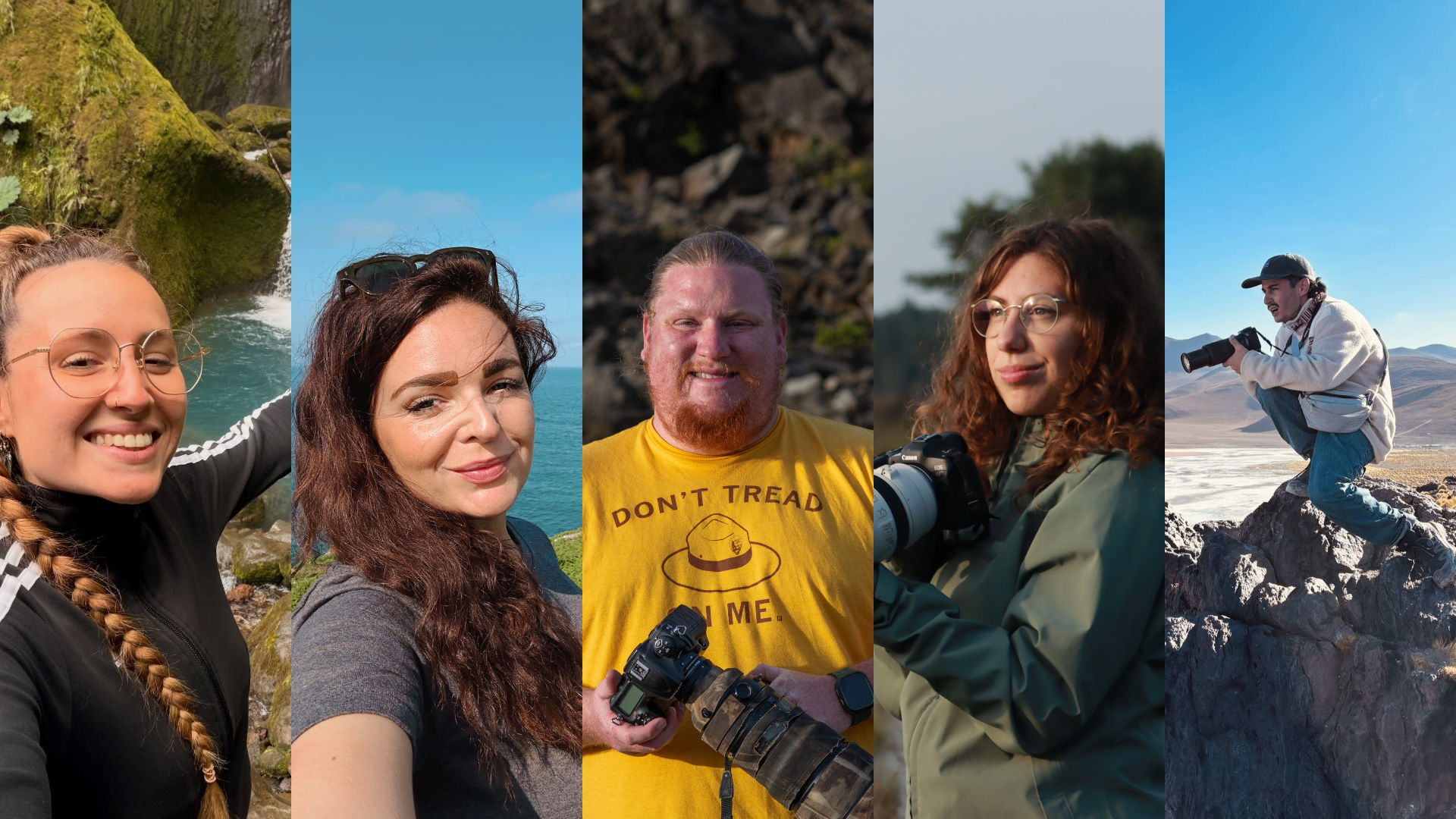
The journey will be documented by five content creators from four different countries (USA, Australia, the UK, and Italy), each bringing their own perspective on how to observe and communicate nature. Through their storytelling, and accompanied by Valerio Russo – CEO of K’Nature – they will act as ambassadors of the region, sharing the experience with a combined audience of over 400,000 followers, documenting the itinerary, the species observed, and the local food traditions encountered along the way.
Let us introduce them!
Jacob De Leo (@birdingwithcob) is an Australian birdwatcher and content creator who has turned his passion into a personal challenge: to see as many bird species as possible around the world. His project, shared with a light and often ironic tone, is inspired by the idea of collecting species, much like a real-life Pokédex.
Marshall Brown (@marshall.travels) brings a broader perspective on landscape and travel. Originally from Delaware, his work combines travel, photography, and visual storytelling to make birdwatching more accessible, with the aim of bringing people closer to nature and encouraging its protection.
Jade Hopcroft (@natureisakingdom) combines photography with conservation, using her images to document biodiversity. Her work has a dual purpose: to capture compelling visuals and to raise awareness about conservation and the importance of biodiversity.
Chiara Talia (@chiaratalia_birds), is an Italian wildlife photographer with a background in Veterinary Medicine and a Master’s degree in Wildlife Conservation. She first approached wildlife photography during her studies as a way to balance academic pressure, eventually turning it into a full-time commitment..
Lisa Mantovani (@lisasanimals) works at the intersection of storytelling and science communication, focusing on animals and their relationship with humans. Having grown up in a nature reserve near Milan, she developed an early connection with wildlife, which she continues today through her work in a wildlife rescue centre.

The journey will begin on April 7th, and we will share it step by step, through images, stories, and moments from the field. Follow along and experience the tour with us:
The press tour took place from 7 to 14 April 2026: read the full report of the completed tour here!